ATS vs Recruitment CRM: Two Tools, Two Different Hiring Problems
Most companies buy the first, complain that hiring is slow, and never notice that the problem was upstream of the tool they bought.
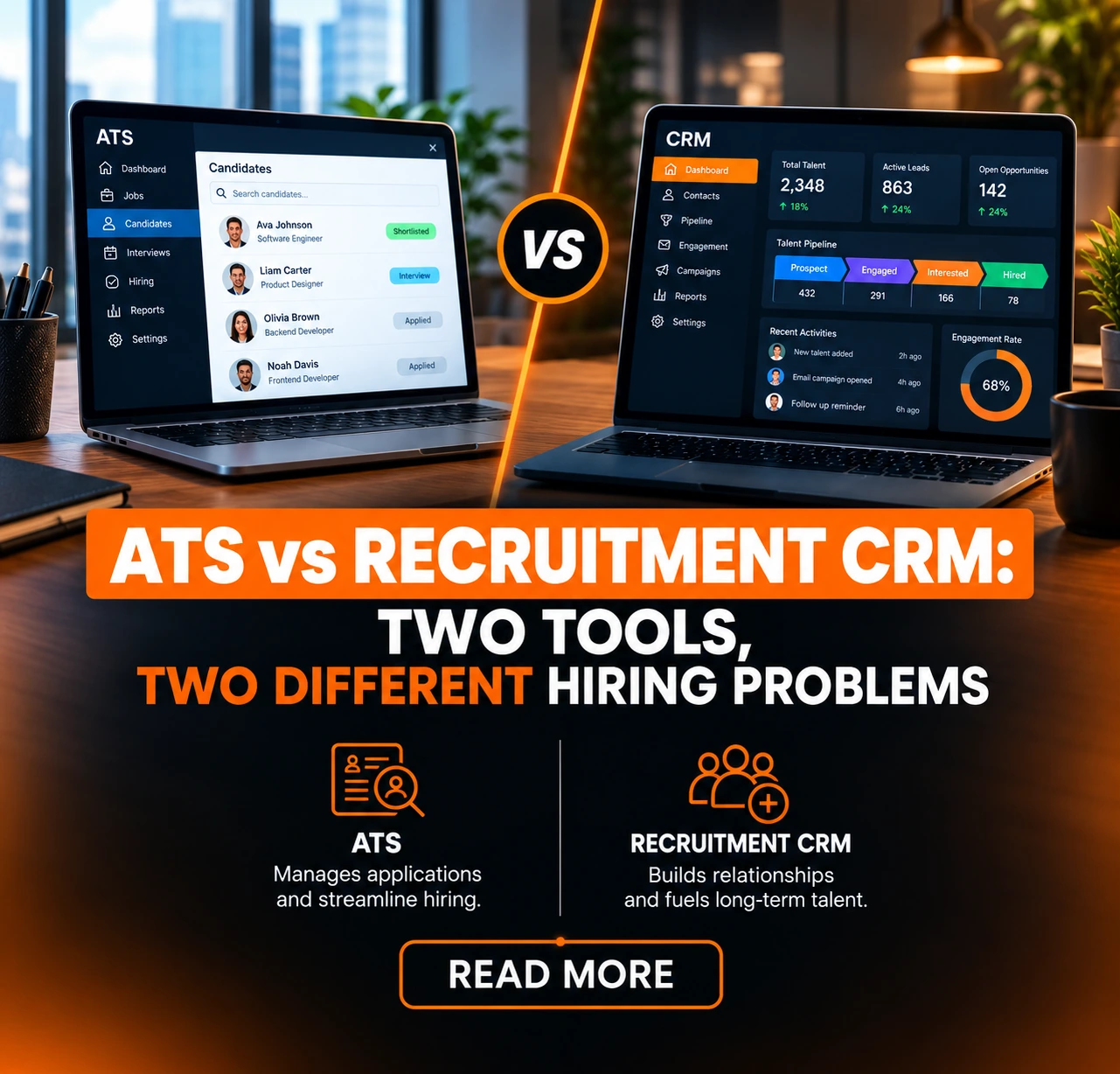
An applicant tracking system manages the people who applied to you. A recruitment CRM manages the people who have not applied — and may not know you are hiring. They look similar in a demo because both hold candidate records, and they solve problems that sit on opposite sides of the moment somebody clicks apply.
The short version
- An ATS manages people who applied. Recruitment CRM systems manage people who have not applied yet.
- Roles filling slowly with plenty of applicants is an ATS problem. Roles sitting open because nobody suitable applies is not, and no ATS will fix it.
- Most suites now claim both. Two questions separate the claim from the capability — see the overlap section.
- When volume is the problem, the ATS wins outright and a CRM is a distraction.
- The real argument for a suite is that a hire becomes an employee record without re-keying.
The difference in one line
An ATS is a pipeline. A recruitment CRM is a relationship.
Everything else follows from that. An ATS is organised around a requisition — an open role, with candidates moving through stages toward an offer, and a record at the end proving how the decision was made.
A recruitment CRM is organised around a person, who exists in it whether or not you are currently hiring for anything they would want.
That is why the two are not competing purchases and why the comparison is worth doing properly. They are not better and worse versions of the same tool. They sit either side of the application, and which one you are missing is decided by where your hiring actually stalls.
One clarification before going further, because the word CRM does a lot of work in software marketing. This article is about CRM in the hiring sense. The sales meaning — pipelines, deals, accounts — is a different product category entirely, covered in what a CRM is and the types of CRM. Recruitment borrowed the acronym and very little else.
What an ATS actually does
The job of an applicant tracking system starts when a requisition is approved and ends when someone accepts an offer or the role is closed.
In between it posts the role to job boards and a careers page, captures applications into one structured record instead of an inbox, screens and filters them, moves candidates through defined stages, coordinates interviews, collects scorecards from interviewers, and produces the offer.
It also keeps the compliance record — who applied, who was rejected, at what stage, and on what stated grounds.
That last function is unglamorous and is frequently the reason an ATS gets bought in the first place. A hiring process reconstructed from four people’s inboxes six months after the fact is not a record, and in a regulated sector or a dispute that matters.
The measurable thing ATS platforms fix is throughput: applications handled per week, days spent between stages, interviews scheduled without four emails each. If your hiring is slow and the pipeline is full, this is the category that helps.
What recruitment CRM systems actually do
Recruitment CRM systems start earlier and finish later. Their unit is a person, not a vacancy.
The core of it is a talent pool that survives the role it was built for. The strongest candidates in most hiring rounds are the ones who came second — qualified, interested, and rejected only because somebody else was marginally better.
In an ATS those people are attached to a closed requisition. In recruitment CRM systems they are a segment you can contact when the next similar role opens.
Around that sit the things that make contacting them reasonable rather than intrusive: outreach sequences, a record of every previous conversation so the next one does not start from nothing, consent and preference tracking, and segmentation by skill, location or seniority.
A cloud recruitment CRM adds the practical benefit that this history is not sitting in one recruiter’s laptop when they leave.
The thing recruitment CRM systems fix is supply: whether anybody suitable is available to apply at all. That is a different problem from throughput and it is not solved by processing applications faster.
| ATS | Recruitment CRM | |
|---|---|---|
| Organised around | A requisition | A person |
| Candidate enters when | They apply | You find them, or they applied once before |
| Record ends when | The role closes | It does not |
| Fixes | Throughput and process | Supply and pipeline for future roles |
| Fails you when | Nobody suitable applies | You are drowning in applications today |
Which one your bottleneck says you need
Do not start from the categories. Start from where the delay actually is, and the category is decided for you.
Roles get plenty of applicants but take weeks to move. That is a process problem, and it is an ATS problem. Look at where candidates sit longest between stages.
It is very often interview scheduling rather than sourcing or screening — a stage that involves three diaries and no automation absorbs days per candidate and is invisible in any report that only measures total time to hire.
Roles sit open because nobody suitable applies. No applicant tracking system fixes this. You can process an empty pipeline instantly and the role is still open.
This is a supply problem, and it is what recruitment CRM systems exist for — building and keeping a pool before the requisition is raised, so that a role opening is a message to fifty relevant people rather than a job posting and a wait.
The same roles keep reopening and you start from scratch each time. A specific and very common version of the second case. If you hire the same three profiles every year and rebuild the candidate list every time, the previous rounds were an asset and you threw them away. That is the clearest possible signal for a CRM.
You cannot answer either question. Then the first purchase is neither: it is measurement. An ATS will give you stage timings as a by-product, which is one honest argument for buying it first even if supply is your real problem.
Where the two overlap, and where vendors blur it
Most ATS systems now claim both functions, and some genuinely have both. The claim is easy to make because an ATS already stores candidate records, and a candidate record with a tag on it can be presented as a talent pool.
Two questions separate the capability from the claim, and both are worth asking in the demo rather than reading in a datasheet.
Can it hold a candidate who has never applied to a requisition? If every person in the system must be attached to a role to exist, it is an ATS with tagging. Sourced candidates, referrals and people met at a careers fair all fail that test, and they are precisely the people a CRM is for.
Can you contact that person again next year without a manual export? Segmenting a pool, checking consent and sending a sequence has to be a normal operation. If the honest answer involves a spreadsheet, the pool is not usable and it will not be used.
The two questions to ask in the demo
Can the system hold a candidate who never applied to a requisition? And can you contact that person again next year without exporting a spreadsheet? A tool that fails either one is an ATS with tagging, whatever the category on the pricing page says.
Screening sits in the overlap too. Structured assessment is genuinely useful on both sides of the application — it qualifies inbound applicants and it tells you whether someone in a pool is worth approaching. An online test management system handles that as its own function rather than as a feature of either category.
When volume is the problem, the ATS wins
There is a case where the CRM argument does not apply, and it is worth conceding plainly rather than arguing round it.
High-volume hiring — seasonal intakes, contact centres, factory recruitment, graduate rounds — usually has no supply problem at all. Applications arrive in the hundreds. The entire difficulty is processing them fairly and fast enough that good candidates have not accepted something else by the time you reply.
In that situation recruitment CRM systems solve a problem you do not have, and time spent building talent pools is time not spent on the queue in front of you.
What you need is screening that narrows honestly, scheduling that does not require a human per booking, and enough structure that two reviewers reach comparable conclusions. Buy the ATS, and revisit the CRM when the shape of your hiring changes.
The general rule holds in both directions: the tool should match where the work actually piles up. Most disappointment with HR ATS systems comes from buying one to fix a shortage of candidates, which was never in its job description.
AI in recruitment, honestly
Recruitment AI is now a feature line on both categories, and the honest position is that some of it is genuinely useful and some of it carries risk that vendors do not lead with.
The useful end is assistive. Parsing a CV into structured fields, drafting a job description that a human then edits, summarising a long application, and finding times that suit three diaries. These save real hours, the output is checked by a person before it matters, and a mistake is visible and cheap.
The end that needs care is automated ranking or rejection. A model that scores candidates learns from previous hiring decisions, and previous hiring decisions carry whatever bias was in them.
A system trained that way can reproduce a pattern nobody would defend if it were written down as a rule — and because the output is a number, it looks objective while doing it.
Two practical positions follow, neither of which requires a view on where the regulation lands. Keep a human decision at every point where a candidate is removed from consideration. And be able to state what the system used to reach a recommendation, because a candidate or a tribunal may ask, and “the model decided” is not an answer.
If you cannot explain why a candidate was rejected without referring to a score, you do not have a screening tool. You have a decision you cannot defend.
Why this belongs inside an HR platform
There is a fair argument for a suite here and it is not the usual one about a single vendor and a single invoice.
It is that hiring does not end at the offer. Someone accepts, and then a person who exists as a candidate record has to become an employee record — personal details, contract terms, start date, reporting line, salary, leave entitlement, payroll.
When those systems are separate, that transition is a re-keying exercise, and re-keying is where data quality goes to die. The employee number gets typed differently, the start date drifts by a day, and the discrepancy surfaces in the first payroll run.
A hire that becomes an employee record without anybody retyping it is the concrete benefit. Everything downstream depends on it being right: personnel management software holds the record, and attendance, leave and payroll all read from it.
This is where recruitment software inside a wider platform earns its place — not because it is a better ATS than a specialist, but because the handover it removes is one of the few integrations that has to work perfectly and usually does not.
Whether it should be part of your HCM software or a best-of-breed tool wired to it is a real decision with a real trade-off, and the answer depends on how much you hire and how much re-keying you are willing to live with.
Whichever way that goes, the diagnosis comes first. A CRM system recruitment teams actually use is one that was bought because supply was the bottleneck — and an ATS bought for the same reason will disappoint no matter how good it is.
An ATS and a recruitment CRM both end at the same place: somebody accepts an offer and has to become an employee. What decides whether that handover costs anybody a morning is the platform underneath — which is what HCM software is for.