Turnstile Gates: Choosing the Right Barrier for Your Entrance
The barrier you need is decided by three numbers, and none of them is on the spec sheet. A practical guide to specifying a turnstile gate.
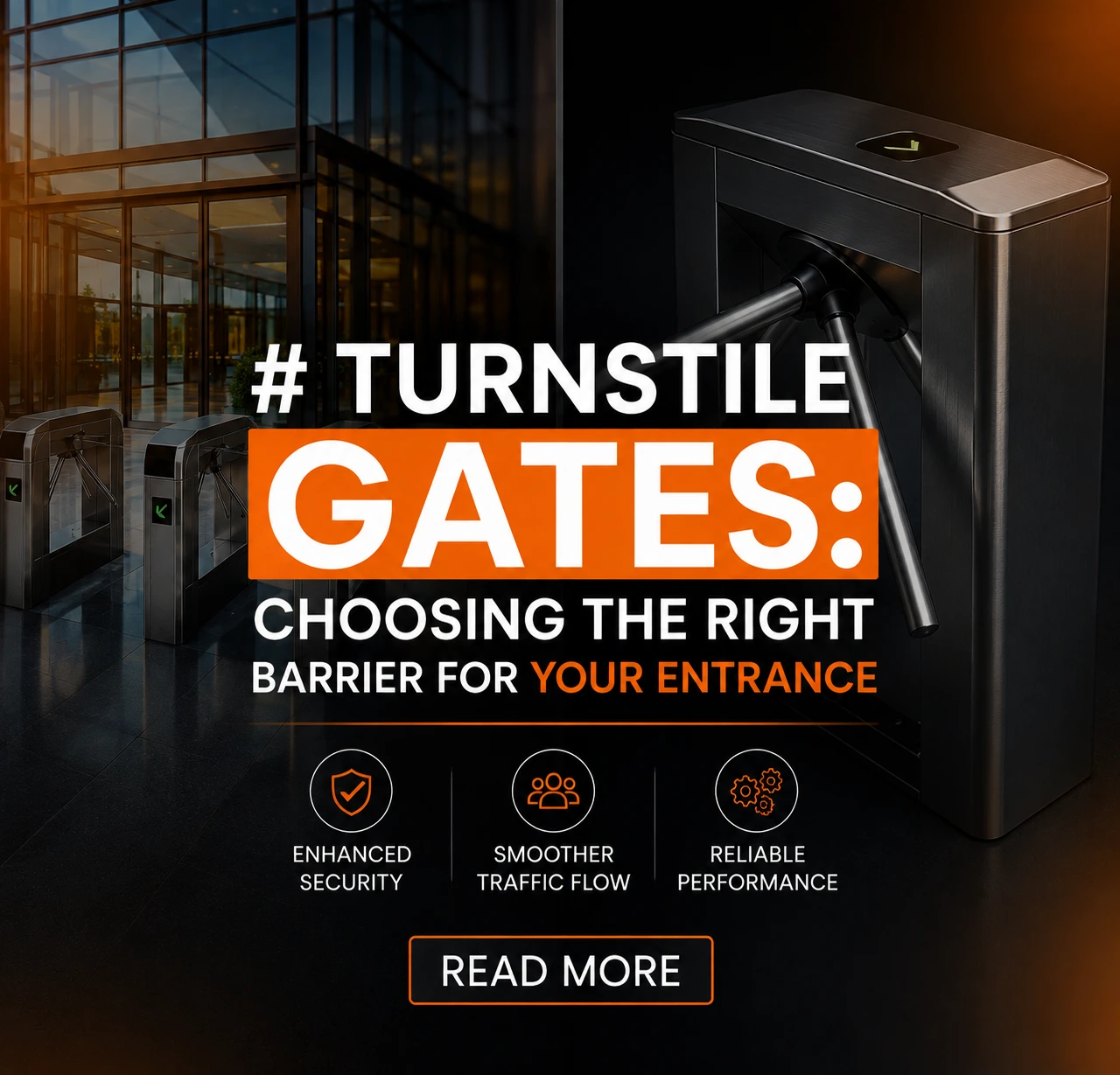
Most turnstile specifications are decided by a product photograph and a price. That is how lobbies end up with a tripod guarding an unmanned entrance, or a full-height cage in a 40-person office. The barrier you need comes down to three numbers, and none of them is on the spec sheet.
The short version
- Only a full-height turnstile physically stops tailgating. Everything else deters or alarms.
- Size lanes against the peak minute, not the daily average — most of a shift arrives in ten minutes.
- Optical turnstiles need a staffed desk. Unmanned, they only log incidents nobody attended.
- Decide the reader before the lane count. Two extra seconds per person is an extra lane.
- Agree fail-safe vs fail-secure with whoever signs off fire safety, not with the installer.
The three questions that decide it
Before comparing hardware, answer these. Every argument later in the article reduces to one of them.
1. What is your peak throughput, not your average? Three hundred people do not arrive across an hour. They arrive in the ten minutes before shift start, and a fair share of those in a single minute. Size for the peak or you are buying a queue.
2. What does one tailgate actually cost you? This is the question that separates the categories. If an unauthorised person following a colleague through the barrier is an annoyance, you need a deterrent.
If it is a safety incident, a regulatory breach, or a payroll fraud, you need something that physically prevents it. Be honest here — most organisations overstate this, and a few badly understate it.
3. Is the entrance supervised? A guard, a receptionist, or nobody. A barrier that alerts is worth having only if someone is there to respond to the alert. At an unmanned gate at 2am, a detection-only system is a logging device, not a control.
Write down the three answers. The rest of this article maps them onto a turnstile gate category, and the categories differ far more than their product photographs suggest.
| Barrier | Stops tailgating? | Throughput | Needs supervision? | Right for |
|---|---|---|---|---|
| Tripod | No — climbable and crawlable | Good | Yes | Supervised lobbies, guarded factory gates |
| Waist-height / flap | Detects and alarms only | Very good | Preferably | Corporate reception, bags and trolleys |
| Optical | No — alerts only | Excellent | Yes, always | High-traffic staffed lobbies |
| Full-height | Yes | Lowest | No | Perimeters, unmanned gates, night shift |
Tripod turnstiles
The default, and correctly so for a large share of installations. Three rotating arms at waist height, one person per rotation, mechanically simple and by some distance the cheapest per lane.
Where a tripod turnstile gate is right: supervised lobbies, factory and site gates with a guard present, anywhere the barrier is there to enforce one-person-one-credential rather than to stop a determined intruder. Throughput is good and the failure mode is obvious — if it jams, everybody can see it has jammed.
The honest limits. A tripod turnstile is climbable and crawlable. An adult of average fitness can get over or under one in a few seconds.
It will not stop anyone who has decided to get past it; it stops casual and opportunistic passage, and it makes deliberate passage visible. If your answer to question 2 was "a safety incident", this is not the turnstile gate you want.
They also handle luggage, trolleys and wheelchairs poorly, which is why almost every tripod installation needs a wide accessible lane beside it. Budget for that lane at the start — it is the single most common omission we see, and retrofitting it usually means moving the whole line.
Waist-height and flap barriers
Retractable or swinging panels that open for an authorised credential and close behind. A waist height turnstile of this kind is sometimes sold as a speed gate or a flap barrier access control system, and the naming varies more between vendors than the hardware does.
Where they earn their cost over a tripod: throughput and appearance. A flap barrier passes people faster than a tripod because there is no rotation to wait for, and it handles bags and trolleys without a separate lane.
In a corporate reception where the barrier is part of the first impression, the difference in how the space reads is significant and is a legitimate reason to spend the money.
Where they do not. Anti-tailgating on a waist-height barrier depends on sensors, not physics. Good units detect a second body and alarm; they cannot stop it. If you are buying a speed turnstile specifically to prevent tailgating rather than to detect it, you are buying the wrong category and paying a premium for the privilege.
They are also more complex than a tripod, which means more to go wrong and a service relationship that matters. Ask what happens when a sensor fails: does the lane fail open, fail closed, or fail into an alarm state that nobody can clear?
A turnstile gate that spends one week a year stuck in alarm is worse than a simpler one that never does.
Optical turnstiles
No physical barrier at all. A sensor array detects passage and direction, validates the credential, and raises an alarm on an unauthorised or unmatched entry.
Optical turnstiles deter and they alert. They do not stop anybody.
The honest framing, which most product literature avoids: their entire value depends on a staffed response — a receptionist who looks up, a guard who intervenes. In the right lobby that is exactly the right trade: the space stays open, throughput is excellent, and the social pressure of a visible alarm does most of the work.
In an unstaffed entrance, this is an expensive way to generate a log of incidents nobody attended. It is the one category where buying the wrong turnstile gate produces no visible symptom at all — the lane works, the log fills up, and nothing is actually being controlled.
They suit high-traffic corporate receptions where the design brief resists visible hardware and there is always someone at the desk. That is a real and reasonably common set of conditions. It is just a narrower set than the category is usually sold into.
Full-height turnstiles
Floor-to-ceiling rotating cages. The only category in this article that genuinely prevents unsupervised tailgating, because there is no over and no under.
Where a full height turnstile gate is the right answer: perimeter fences, unmanned entrances, night-shift access, substations and yards, anywhere the honest answer to "is anyone watching?" is no. If you need the barrier to work at 3am with nobody present, this is the category, and the others are not substitutes for it.
What it costs you beyond the price. Throughput is lower than every other option — the rotation is slower and people are more cautious inside a full-height unit. They need more space and a proper foundation.
And they are intimidating, which matters more than specifiers expect: a full height turnstile at a main visitor entrance sets a tone that is very hard to soften with signage.
The usual resolution is to mix categories rather than standardise: a full height turnstile gate on the perimeter and the unmanned entrances, something lighter at the staffed front door. Two categories on one site is normal and is not a sign of poor planning.
One practical note on procurement. Because a full-height unit is the only category that physically prevents tailgating, it is frequently specified for entrances that do not need it, on the reasoning that more security cannot hurt.
It can: every extra second of passage time at a busy entrance is a queue, and a queue is where people start propping barriers open. Match the turnstile gate to the supervision, not to the anxiety.
Choosing the reader, not just the barrier
The barrier decides what physically happens. The reader decides how long each person stands there deciding it, and that feeds straight back into your throughput number.
Cards. Fastest at the door and cheapest per user, and the only technology here that cannot prove who presented the credential. Right where speed dominates and buddy passage does not matter much. More on the trade-offs on our page for proximity card readers.
Fingerprint. Proves the person, costs a second or two more per passage, and has a real enrolment-failure population in manual trades — worn fingertips, moisture and dust all degrade it. See finger print terminals for where it does and does not hold up.
Face. Contactless and fast once tuned, works where fingers do not, and is sensitive to lighting — particularly backlight from a glass entrance. Face recognition devices covers the detail.
One rule that saves rework: decide the reader before you finalise the lane count, not after. A technology that adds two seconds per person to a 300-person shift change is not a detail, it is an extra lane.
Fail-safe, fail-secure, and the fire exit
This is the part of a turnstile specification with genuine consequences, and it is the part most likely to be settled by whoever is installing rather than by whoever is accountable.
Every barrier has to do something defined when power is lost. Fail-safe means it releases and people can pass freely. Fail-secure means it stays locked. Neither is universally correct: fail-safe on a perimeter gate hands you an open perimeter during an outage, and fail-secure on an egress route is a serious life-safety problem.
Most sites end up with a split — fail-safe on anything forming part of an escape route, fail-secure elsewhere, and a monitored override for the exceptions. Full-height turnstiles usually need a dedicated adjacent emergency gate rather than a fail mode of their own, because a cage that unlocks is still a slow way out.
Settle this before you agree the hardware
Fail modes on an escape route are a life-safety matter, not an access-control preference. Get the requirement that applies to your building in writing, and have whoever signs off fire safety agree it — not the installer, and not this article.
We are deliberately not quoting a code requirement here. Fire and egress rules vary by jurisdiction, by building classification and by occupancy, and a specific clause quoted in a general article is exactly the kind of thing that gets copied into a specification without being checked.
Establish the requirement that applies to your building, in writing, before you agree the fail modes — and have whoever signs off fire safety agree them, not the access-control installer.
Working out how many lanes you need
Lane count is arithmetic, but it has to be done against the right number.
Start with the population that arrives at the busiest entrance in the busiest period. Each turnstile gate category has a different passage time, so this arithmetic has to be redone if the barrier choice changes.
Then compress it: in most workplaces a large majority of a shift arrives inside a ten-minute window, and within that there is a sharper peak in one or two minutes. Take your headcount for that entrance, decide what fraction lands in the peak minute, and that is your input.
Then work out passage time per person for the barrier and reader combination you have chosen — measured, not from a brochure. Divide, and add a lane, because one lane out of service for maintenance should not create a queue into the car park.
We have not put throughput figures in this article on purpose. Published passages-per-minute numbers are measured under conditions that do not resemble a shift change: cooperative users, no bags, no card fumbling, no first-time enrolment failures.
The only number worth designing against is one measured on comparable hardware with a comparable population. If you are replacing an existing installation, count your own peak before you specify the new one — you already have the best available data.
What the barrier is worthless without
A turnstile gate that is not connected to anything is a door that spins. It enforces one person per credential and produces nothing else.
The value appears when the passage event becomes a record: who entered, at which gate, at what time, and whether that matches what payroll thinks about their shift.
That is when a gate stops being a security fixture and starts answering questions — why a contractor was on site on a Sunday, whether the overtime claimed matches the time the gate saw, which visitor is still in the building during an evacuation.
It is also the point at which a gate pass management system becomes tractable. Issuing visitor and contractor credentials that expire on their own, and knowing without a phone call who is currently inside, is a records problem rather than a hardware one — no barrier solves it, and every barrier benefits from it being solved.
Vendors will describe the same assembly as a turnstile access control system, a gate access control system, or simply as gate entry, depending on which part they want you to focus on.
The words are close to interchangeable. What is not interchangeable is whether the passage event is written somewhere useful, and that is worth asking about explicitly rather than assuming.
Getting there means the barrier, the reader and the door access control system behind them are specified as one thing rather than three.
Hardware chosen first and integration considered afterwards is the most expensive order to do this in, and it is the usual one. A turnstile gate bought on price alone routinely costs more over five years than the integrated option it undercut.
Entrance hardware only pays for itself once the passage record reaches the systems that use it — attendance, rostering and payroll. human capital management software is where a gate event turns into a shift, an exception or a paid hour.