The Performance Management Process: Designing a Cycle People Take Seriously
The design problem was never the form. It is that managers are asked to rate people against goals written once, twelve months ago, by someone who has since changed job.
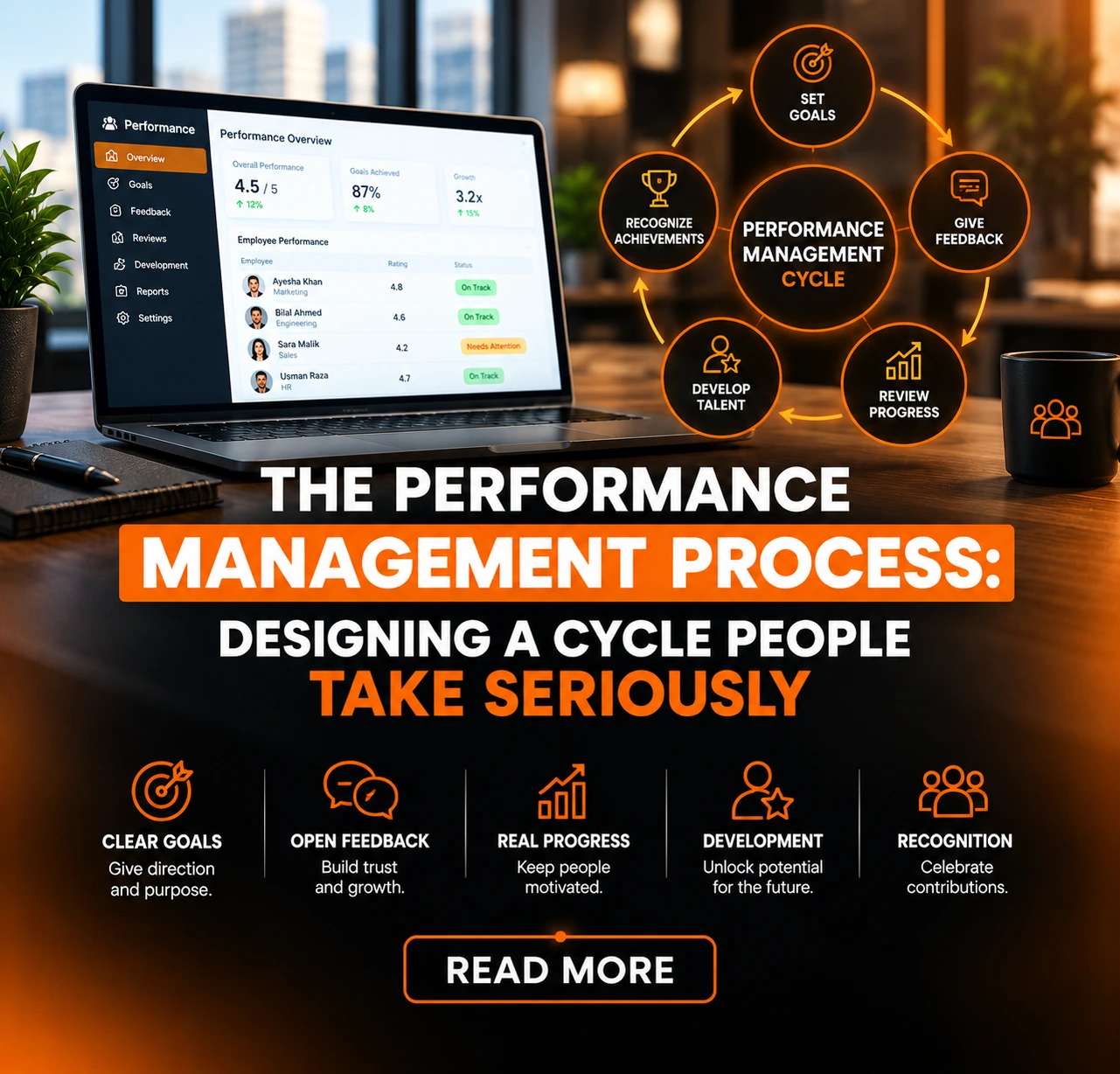
The performance management process is the full loop a company runs to set expectations, track them, judge them and act on the judgement. In most organisations it has quietly collapsed into a single annual form, which is why it is disliked by the people filling it in and distrusted by the people it is filled in about. The form is not the problem.
The short version
- The performance management process is five stages, not one event: goals, check-ins, review, calibration, outcome.
- Goals fail on ownership, not on wording. Decide who owns a goal when the manager changes, before the year starts.
- Calibration is the stage most companies skip, and it is why a rating means different things in different departments.
- A cycle connected to nothing will be ignored within two years. Connecting it to pay changes manager behaviour — plan for that.
- 360 feedback is a development tool. Wire it to pay and you change what people write.
- Software makes the cycle run on time and keeps the evidence. It does not make managers have the conversation.
What the performance management process actually contains
Five stages, running continuously rather than once a year: goal setting, ongoing check-ins, the review, calibration, and the outcome. Skip any one of them and a predictable failure follows, and each is described below.
Written out like that it sounds obvious. In practice the performance management process in hr teams usually consists of stage one done briefly in January, stage three done under duress in December, and stages two, four and five not done at all. That is not a performance management process.
It is an annual event with a form attached, and it produces exactly what you would expect: ratings that reflect the last six weeks, managers who cannot recall the goals they set, and employees who have correctly concluded that none of it changes anything.
The performance management appraisal process is worth separating into its parts for one practical reason: the parts fail differently and they are fixed differently. A company whose ratings are meaningless has a calibration problem. A company whose goals are irrelevant by June has a cadence problem.
A company where nobody takes the cycle seriously has an outcome problem. Those are three different repairs, and treating them all as "we need a better appraisal form" is why so many redesigns change the form and nothing else.
Stage 1 — goals that survive the year
The single most common design failure in the performance management process is not badly written goals. It is goals nobody owns by the time they are assessed.
A goal is set in January by a manager who moves to another team in May. The employee reports to someone new who did not write the goals, does not know what was intended by them, and has their own priorities.
In December that new manager rates performance against objectives they had no part in setting. Everyone involved knows the exercise is hollow, and it is.
Decide the ownership rule before the cycle starts, and write it down. When a manager changes, does the new manager inherit the goals as written, review and reset them within a fixed window, or does the previous manager contribute to the final assessment?
Any of the three is defensible. Having no rule is not, and it is the default almost everywhere.
The second failure is goals written against priorities that no longer exist. The honest fix is not better forecasting, it is permission to change them: a stated, lightweight mechanism to revise a goal mid-year with a note of why.
Without that, people either quietly abandon the goal or hit a target that stopped mattering in March — and the second is worse, because it rewards the wrong work.
Keep the number small. Where every project becomes a goal, the list stops being a statement of priority and becomes an inventory, and an inventory cannot be used to make a judgement at the end of the year.
Stage 2 — check-ins, where cadence beats ceremony
A quarterly conversation that takes twenty minutes is worth more than an annual one that takes two hours, and the reason is evidence rather than sentiment.
The annual review asks a manager to assess twelve months of work from memory. Memory does not work that way — the last few weeks dominate, and everything before them compresses into an impression. No rating scale corrects for that. Only a record made closer to the event does.
A check-in must produce a written note. That is the whole mechanism. Not a form, not a rating, not a meeting in a calendar: three or four lines recording what was discussed, what changed about the goals, and anything notable either way.
A check-in that produces only a feeling has not produced anything, and by December it has evaporated.
Those notes are what make the review defensible later. When a manager says at year end that delivery slipped in the second quarter, either there is a note from the second quarter saying so or there is not — and if there is not, the employee is hearing it for the first time in the conversation that decides their rating. That is the situation every grievance procedure is designed around, and it is entirely avoidable.
Stage 3 — the review, and the biases in it
The review pulls together evidence from the year, a self-assessment, and the manager’s judgement. The self-assessment is worth including for one specific reason: where the employee’s view and the manager’s view diverge sharply, that gap is the most useful information the whole cycle produces, and it will not surface any other way.
Rating scales carry well-documented distortions, and naming them is what separates a designed cycle from a copied one.
Central tendency — raters cluster everyone in the middle, because the middle requires no justification. The output is a distribution that carries no information at all.
Recency — the last quarter outweighs the first three. This is the bias the check-in notes exist to counter.
Leniency drift — ratings inflate over time, because a low rating costs the manager a difficult conversation and a high one costs nothing today. Left alone, this is why a scale that once meant something ends up with almost everybody at the top of it.
The halo effect — one visible strength or failure colours every other dimension of the assessment.
None of these are solved by adding rating points or renaming them. They are addressed at the next stage, which is the one most organisations do not run.
Stage 4 — calibration, the stage everyone skips
Calibration is a meeting where managers review their proposed ratings together, before anything is communicated, and justify them against each other.
It exists because a rating is not an absolute measurement. It is one manager’s judgement, and managers differ enormously in severity. Without calibration, a “meets expectations” in one department and the same words in another describe different standards of work, and every downstream decision — promotion, pay, succession — inherits that inconsistency while presenting it as a number.
If you have never calibrated, you do not have a rating scale. You have several, one per manager, printed on the same form.
Running it does not require a forced distribution, and it should not. The purpose is not to fit ratings to a curve — that creates its own injustice and is widely regretted where it has been imposed.
The purpose is for a manager to state what a rating means in their team and to hear whether their peers apply the same standard.
Two practical notes. It has to happen before ratings are shared, or it becomes a process for retracting things people have already been told. And it needs the evidence in front of it — which is the first point in this cycle where having the check-in notes in one place stops being a nicety.
Stage 5 — what the outcome connects to
At the end of the performance management process a judgement exists. What happens to it determines whether anybody takes the next cycle seriously.
Connected to nothing. The most common arrangement and the most corrosive. If a rating changes no pay, no progression and no development, people work out within two cycles that the exercise is administrative, and the quality of what they write collapses accordingly.
A cycle with no consequence is not a light-touch cycle; it is a cycle that has stopped functioning while continuing to consume everyone’s December.
Connected to pay. Legitimate and common, and it changes manager behaviour in ways that must be planned for rather than discovered. Once a rating sets a number, every conversation becomes a negotiation, leniency drift accelerates sharply, and honest developmental feedback becomes expensive for the manager to give.
None of that is an argument against it. It is an argument for calibration, and for holding the development conversation separately from the pay conversation.
Connected to development. The most useful and the most frequently promised without being delivered. If a review identifies a gap and nothing follows, the promise has been broken visibly.
Following through means the outcome reaches whatever runs training — which is the point at which employee training software stops being a separate system and becomes the second half of the appraisal.
Decide this before designing anything else. Everything upstream — how many ratings, how much evidence, how much calibration — follows from what the outcome is for.
360 feedback: when it helps and when it backfires
Multi-rater feedback collects input from peers, direct reports and others alongside the manager. It is written as a 360 degree feedback appraisal system, a 360 degrees appraisal system or simply a 360 appraisal system; the names are interchangeable and the mechanism is the same.
It is genuinely valuable for development. A manager’s view of someone is a partial view, and for behaviours that show up sideways — collaboration, how someone handles disagreement, whether people can rely on them — peers and reports see things a manager structurally cannot.
It backfires in two specific conditions, and both are predictable.
The first is wiring it to pay. The moment feedback affects someone’s salary, the incentive shifts from being useful to being safe or being strategic.
Reciprocal arrangements form, criticism disappears, and the instrument stops measuring what it was built to measure. If you take one design rule from this section: use 360 feedback for development, and keep it out of the pay decision.
The second is running it in a low-trust team. Where people do not believe the responses are genuinely anonymous, or where there is an unresolved conflict, the exercise becomes a channel for it.
A 360 rollout is not a way to surface a problem you already know about; it will make that problem worse and take the credibility of the tool with it.
Practically, anonymity has a floor. With three respondents nothing is anonymous, whatever the software claims, and people write accordingly. Either gather enough responses for aggregation to mean something or be honest that it is attributed feedback. The collection mechanics matter here more than in any other stage, which is where a survey management software tool earns its place.
Scorecards and cascaded objectives, briefly
A balanced performance scorecard sets objectives across several dimensions rather than financial results alone — typically financial, customer, internal process, and learning or people.
The idea it is built on is sound and worth keeping even if the framework is not adopted wholesale: judging a department on one number produces optimisation of that number at the expense of everything around it, and the classic case is cost reduction that quietly consumes quality or turnover.
The honest limitation is that cascading objectives down an organisation works cleanly on a slide and rarely on the ground. By the third level down, individual goals frequently bear only a decorative relationship to the corporate objective they were derived from, and maintaining the map costs more than the alignment is worth.
Use the dimensions as a check that you are not measuring one thing to the exclusion of others. Treat a fully cascaded tree with more caution than the diagram invites.
Designing your performance management process
Designing a performance management system is a series of decisions in a particular order, and taking them out of order is what produces a cycle that has to be redesigned two years later. This is deliberately not a software requirements list — every decision below is about the cycle, and none of it needs a product chosen first.
1. Decide what the outcome is for. Development, pay, progression, or a stated combination. Everything else follows and nothing else can be settled until this is.
2. Set the cadence. How often check-ins happen and how often a formal review does. Quarterly and annual is a common, workable answer.
3. Choose the evidence. What a manager is expected to have in front of them at review time, and where it accumulates during the year.
4. Choose the scale, then define every point on it in writing. A five-point scale where the points are not defined is a five-point scale where each manager has invented their own definitions.
5. Design the calibration meeting. Who attends, what they see, and what authority the meeting has to change a rating.
6. Write down the manager-change rule from stage one.
7. Decide what employees see and when. Whether they see the final rating before the conversation, and whether they can respond in writing on the record.
Two notes on scope. Designing a performance appraisal system for the first time is better done narrowly and extended later — one business unit, one cycle, then widen.
And designing an appraisal system is not the same as buying one: a staff appraisal system that nobody has agreed the rules for will not be rescued by the software chosen to run it, and an employee appraisal system with the rules settled can be run on very little.
Where software helps, and where it cannot
This is the section to be honest in, because the temptation to overclaim is strongest here.
What software genuinely does. It makes the cycle run on time, which sounds trivial and is most of the battle — goals get set because the system asks, check-ins happen because they are scheduled, reviews close because the deadline is visible to somebody.
It keeps the evidence in one place, so the check-in note from the second quarter is actually available in the fourth. It makes calibration possible, because the distribution of proposed ratings across departments can be seen before anything is communicated. And it holds the record, which matters on the day someone disputes an outcome.
What it cannot do. It cannot make a manager have the conversation. It cannot make a vague goal specific. It cannot make feedback honest in a team where honesty is unsafe.
Every failure described in this article — goals nobody owns, ratings that mean different things, an outcome connected to nothing — is a design failure, and a system will run a badly designed performance management process punctually and completely.
That is the case for settling the design first and choosing the tool second. Once it is settled, a performance management system is what stops the cycle degrading back into an annual form, and it reads from the same employee record as personnel management software so that a rating, a promotion and a pay change are one chain of events rather than three separate spreadsheets.
The reason it belongs with the rest of the employee record rather than beside it is straightforward: an outcome that has to be re-keyed into payroll or a training plan is an outcome that will sometimes not be, which is the argument for HCM software holding the whole cycle.
A performance management process produces decisions — a rating, a development plan, sometimes a pay change — and every one of them has to reach a system that acts on it. Keeping the cycle on the same employee record as pay, leave and training is what HCM software is for.