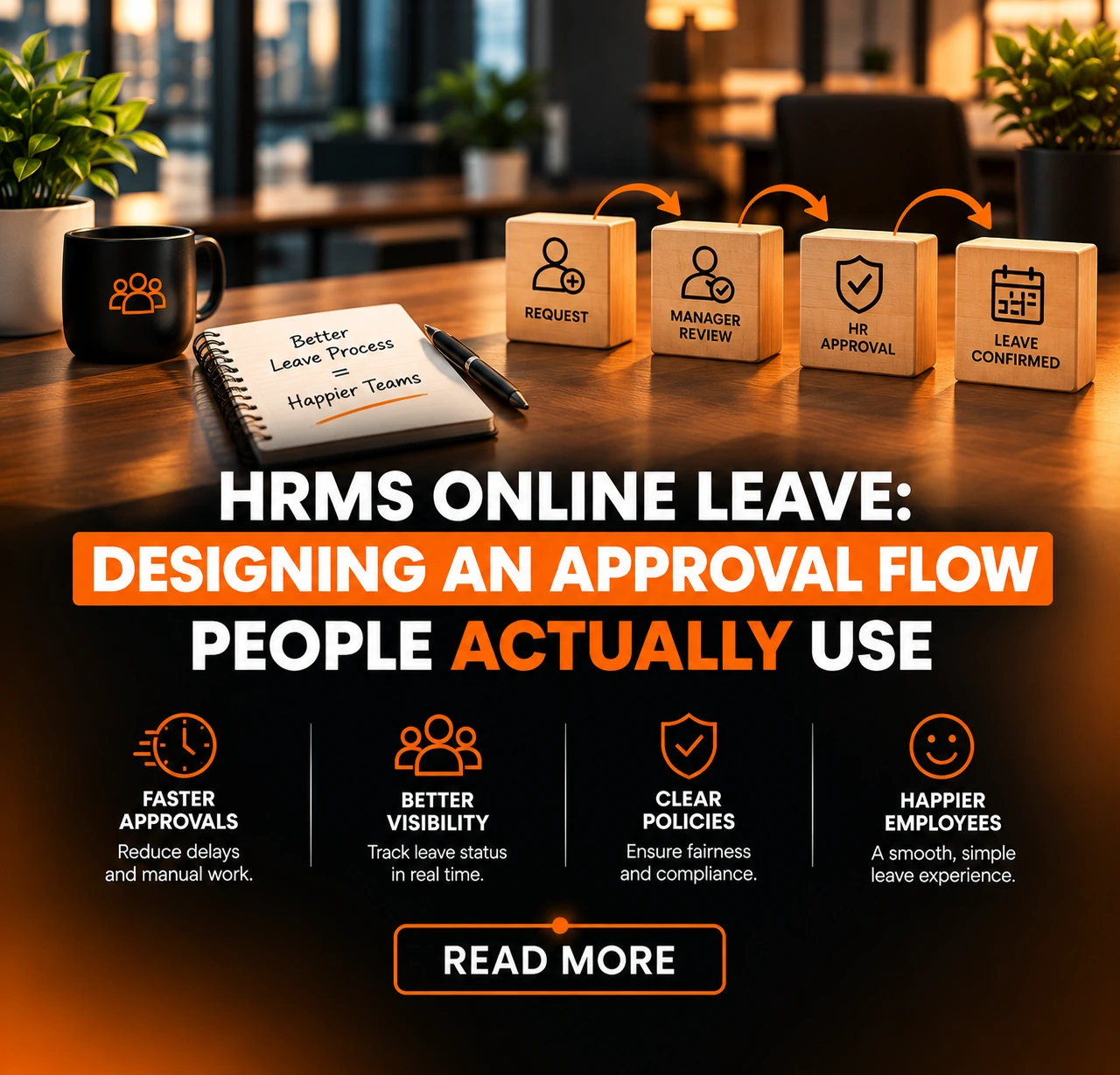
HRMS Online Leave: Designing an Approval Flow People Actually Use
The software is rarely the problem. The escalation path almost always is — and nobody designs it until it deadlocks.
An HRMS leave application replaces four things at once: the email nobody can find, the balance nobody trusts, the manager who approved without knowing who else was out, and the payroll run that discovered the unpaid leave three weeks late. Most implementations fix the first and quietly leave the other three in place.
The short version
- Design the escalation path before the form. Deadlock is the failure mode, and it is entirely predictable.
- Name a delegate for every approver. The approver being on leave themselves is not an edge case.
- Decide whether silence approves or blocks. Either is defensible; stumbling into one is not.
- A balance shown to an employee that disagrees with HR’s number destroys trust faster than any outage.
- The team calendar is what managers actually use — approving blind is how coverage gaps happen.
- For staff with no company email, the answer is a phone or a kiosk, not a portal.
- An HRMS leave application is only believed if its balance matches HR’s. Encode the rules before switching balances on.
What the paper-and-email loop actually costs
Before designing anything, it is worth being precise about what is broken, because "we use email" hides four separate failures.
The balance is wrong, or nobody is confident it is right. It lives in a spreadsheet one person maintains, and every request needs that person to check it. The employee does not know their own balance without asking, which means they ask.
The manager approves without seeing the team. Nothing in an email says who else is off that week. Coverage gaps are found afterwards, usually by the people covering.
Payroll finds out late. Unpaid leave, encashment and anything affecting pay arrives as a message near the cut-off, or after it.
There is no record of who approved what. Six months later, a disputed absence is reconstructed from memory and an inbox, which is not a record.
An HRMS leave application closes all four, but only if the flow behind it is designed. Digitising the form alone moves the same problems into a nicer interface.
The category carries several names and they describe the same thing: an online leave management system, leave request software, a leave tracking tool, or an HRMS leave management system where it is part of a wider platform.
Vendors use whichever phrasing their buyers search for. What actually varies between products is not the label but how much of the flow below they let you configure.
The flow, end to end
An HRMS leave application runs through six stages. Most implementations configure two of them and discover the rest in production.
1. Request. The employee selects a type and dates. The type matters more than it looks — annual, sick, unpaid and special leave behave differently downstream, and collapsing them into one type to simplify the form is the decision people regret.
2. Validation. Before the request reaches anybody, the system checks it against the balance and the policy: is there entitlement left, is the notice period met, does it clash with a blackout period. A request that cannot be approved should fail here, not after a manager has considered it.
3. Approval. One approver, or several. This is where flows break and it has its own section below.
4. Calendar and roster. The absence becomes visible to the team and, where shifts are planned, to whoever plans them.
5. Payroll effect. Unpaid days, encashment and anything else touching pay reaches the payroll run without being re-keyed.
6. Record. Who requested, who approved, when, and against which balance — retained.
| Stage | Fails when | Symptom |
|---|---|---|
| Validation | Policy is not encoded | Managers enforce rules inconsistently |
| Approval | No delegate, no escalation | Requests sit for days |
| Calendar | Approver cannot see the team | Coverage gaps |
| Payroll | Systems are not connected | Unpaid leave missed or applied late |
| Record | Approvals happen outside the system | Disputes cannot be settled |
Where approval chains break
This is the section worth reading twice, because every failure below is predictable and almost none of them is designed for. It is also where an HRMS leave application is most often blamed for a problem that is entirely a configuration decision.
The approver is on leave. The single most common deadlock, and the most obviously foreseeable — this is a leave system. Every approver needs a named delegate, and the delegation has to be something the approver can set themselves before going away, not a support ticket.
The second approver never logs in. Chains routinely end at a director who approves nothing because they were never really going to.
Either that step is real, in which case they need a reason to log in and a delegate, or it is theatre and should be removed. A step that is always skipped is worse than no step: it makes the record say something untrue.
Nobody defined what happens after N days. An escalation window is a policy decision, and it has exactly two honest answers.
Silence approves, or silence blocks — decide, do not drift
Auto-approving after a set period keeps people moving and accepts that some leave is approved by inattention. Blocking until someone acts keeps control and accepts that requests will stall. Both are defensible. What is not defensible is discovering which one you implemented when somebody has already booked a flight.
The approver has left the company. Requests routed to a departed manager are the quiet version of this problem, because nothing errors — the request simply waits. Reassignment on termination belongs in the leaver process, not in the leave system’s configuration.
The request needs approving by the person requesting it. Small teams hit this immediately: the manager’s own leave routes to the manager. Decide who approves the approver before go-live.
Balances are where trust is won or lost
An HRMS leave application is only believed if the number it shows is the number HR would give.
That sounds trivial and it is the most common source of complaints after go-live, because the two are calculated differently more often than anyone expects. Entitlement granted annually in advance behaves differently from entitlement accrued monthly.
Carry-forward may be capped, may expire on a date, or may need approval. Someone joining in the middle of the year has a pro-rata figure that depends on a rounding rule nobody wrote down.
Encode the rules before the balances go visible. The failure sequence is always the same: balances are switched on, an employee sees a number lower than they expected, HR investigates, and the rule turns out never to have been written down — only applied case by case by someone experienced. Digitising an undocumented policy is how you discover it was never a policy.
Leavers deserve the same care. A final settlement including untaken leave has to use the same calculation the employee has been watching all year, or the last thing they experience is an argument.
This article states no entitlements, accrual rates or notice periods on purpose. They vary by jurisdiction, sector and contract, they change, and a figure published here would be wrong somewhere and stale eventually. Take them from your own policy and the applicable law.
The team calendar is the feature managers use
Ask a manager what they want from an HRMS leave application and they will describe an approval button. Watch one use it and they are looking at the calendar.
Approving a request without knowing who else is out is the mechanism behind almost every coverage gap. The manager is not careless; the information simply was not in front of them. Putting the team’s absences on the approval screen changes the decision more than any policy rule, because it converts an isolated yes into a scheduling judgement.
Two refinements that earn their keep. Show who is out rather than a count, because a team of eight can lose two people and be fine, or lose two specific people and stop.
And where shifts are planned, the approved absence has to reach the roster, or leave is approved against a plan that already assumed the person was there.
What it has to connect to
Leave is not a self-contained module. Three connections decide whether the record is worth anything.
Attendance. An absence with no approved leave against it is an exception someone must resolve; an absence with approved leave is simply a day off.
Without the connection, every absence looks identical and somebody reconciles them by hand each month. This is the argument for leave and the attendance management system reading the same record rather than being reconciled to each other.
Payroll. Unpaid leave and encashment change pay, and they are the classic case of a monthly re-keying step that produces errors under deadline pressure — the argument the cloud payroll piece makes at length, so it is not re-argued here.
The employee record. Joining date drives pro-rata entitlement, and reporting line drives the approval route. Both live in the personnel record, and a leave system holding its own copy of either will disagree with it eventually. Where they are shared, HRMS leave records and attendance records describe the same day rather than needing to be reconciled into agreement.
Where all three sit on one record, the flow described above runs without anybody transcribing anything, which is what HCM software is for. Where they do not, an online leave system is still worth having — it just leaves the monthly reconciliation in place.
The people with no company email
Every design above assumes the employee can reach the system. For a large part of the workforce in manufacturing, construction, retail and field services, that assumption is wrong.
Someone without a work email address and without a desk cannot use a portal, and a leave process they cannot reach is a leave process that stays on paper for them — which means it stays on paper, because a system covering only the office half is a system HR still administers manually.
Two workable answers. A phone app, where the workforce has suitable phones and is willing to use them for work, which is a question to ask rather than assume.
Or a shared terminal: an employee self service point where people already pass, which is also where they check payslips and balances. The kiosk case is strongest exactly where email coverage is weakest.
Whichever is chosen, the approval side still has to work for a supervisor who does not sit at a computer either. An approval flow designed around a desk will route to someone who is on a factory floor, and it will sit there.
Leave touches attendance, payroll and the employee record on the same day it is approved. Keeping those on one record — so an approved absence is not re-keyed three times — is what HCM software is for.