Perpetual vs Periodic Inventory: Which System Your Books Actually Need
Periodic is not the old way and perpetual is not the modern way. One updates the record on every movement; the other updates it when you count. Which one you have is a question of discipline, not software.
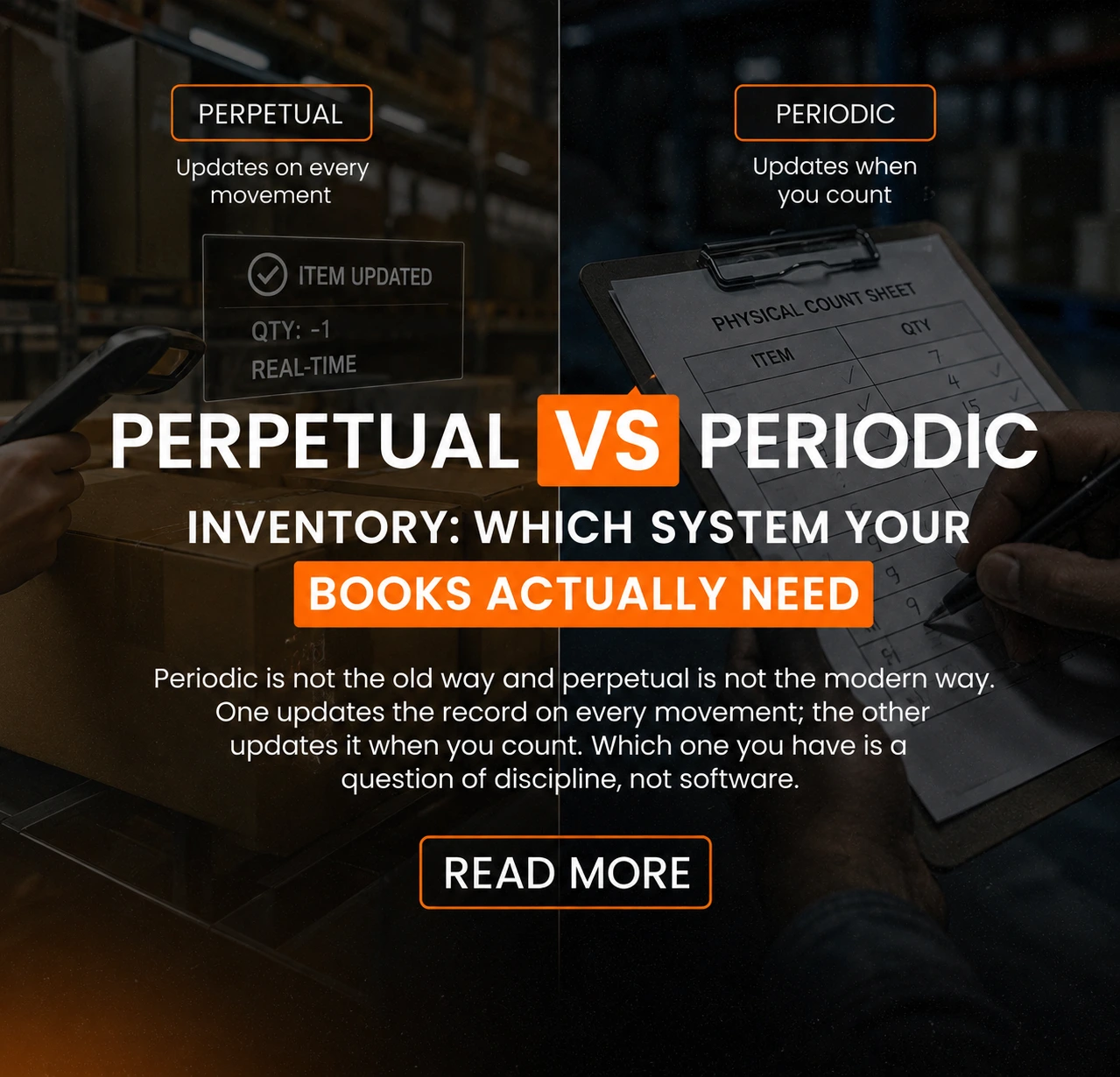
A perpetual inventory system updates the stock record on every single movement. A periodic system updates it only when somebody physically counts. That is the whole distinction, and almost everything else written about it is elaboration. What trips people up is that most businesses assume they run perpetual because they bought software — when what they actually run is periodic with a spreadsheet in front of it.
The short version
- Perpetual updates on every movement. Periodic updates when you count. Everything else follows from that.
- The diagnostic: can you state today’s stock on hand without counting, and does anyone believe the number?
- Periodic is not obsolete. For low-value, high-volume, fast-consumed items it is often the rational choice.
- Perpetual does not abolish stocktaking. It converts an annual shutdown into cycle counting.
- A perpetual system fed by careless data entry is worse than an honest periodic one, because people believe it.
The one-line difference
In a perpetual inventory system, every receipt, issue, return and adjustment posts to the stock record as it happens. Ask what you hold at eleven on a Tuesday morning and the system has an answer.
In a periodic inventory system, purchases accumulate in one account and the stock figure is established only when somebody walks the racks and counts. Between counts, the recorded figure is a historical fact rather than a current one.
The comparison between a periodic inventory system and a perpetual inventory system is usually framed as old versus new. That framing is wrong and it is why so many finance teams misidentify their own method.
Periodic is a legitimate current choice for some categories of stock. Perpetual is an ambition that fails quietly whenever the discipline behind it lapses.
How a periodic system actually works
Purchases go to a purchases account as they are invoiced. Nothing posts to inventory as goods move. At period end — month, quarter or year — you count what is physically there, value it, and work backwards to cost of goods sold: opening stock, plus purchases, less closing stock.
The appeal is that it demands almost nothing of the operation day to day. Nobody scans anything. Nobody has to be trained to record an issue. The cost is concentrated into the count, and the count is the only moment the figure is true.
Periodic inventory systems remain entirely legitimate in several situations. Consumables of low individual value and high consumption — fasteners, packaging, cleaning supplies — where tracking each issue costs more than the item.
Very small operations where the person buying stock is the person using it and holds the picture in their head. And any category where the effort of perpetual capture would demonstrably exceed the value of knowing the number sooner.
What periodic cannot do is tell you today whether you can accept an order. If that question matters, the method is wrong regardless of how well the count is run.
How a perpetual system works
Every movement posts immediately. Goods receipt increases the record; an issue to production or a despatch decreases it; a return, a damage write-off and a stock adjustment each post as their own transaction with a reason attached.
Cost of goods sold is therefore calculated continuously rather than derived at period end, and the physical count changes role entirely. Under periodic, the count is the stock figure.
Under a perpetual stock system, the count is a verification of a figure the system already holds — and the variance between the two becomes a measurement of how well your processes are working.
That variance is the most useful number a perpetual inventory control system produces, and it is the one most often ignored. A business that counts, finds a difference, adjusts the system to match and moves on has spent the cost of perpetual and kept the information content of periodic.
The same transactions under both methods
The clearest way to see where the two diverge is to run identical activity through each.
All figures below are illustrative and chosen for arithmetic clarity. They are not drawn from any client, and they are not benchmarks.
Opening stock: 100 units at 50 each, so 5,000. During the month you buy 200 units at 50, and you sell 180 units.
| Point in the month | Periodic | Perpetual |
|---|---|---|
| After the purchase posts | Purchases 10,000. Inventory still shows 5,000. | Inventory 15,000, 300 units. |
| After each sale | No inventory entry at all. | Inventory reduces, COGS increases, sale by sale. |
| Mid-month, stock on hand | Not available without counting. | 120 units, 6,000, on demand. |
| Cost of goods sold | Derived at period end: 5,000 + 10,000 − closing count. | Already 9,000, accumulated transaction by transaction. |
| What the count tells you | The stock figure itself. | The variance against what the system expected. |
Now the interesting part. Suppose the count finds 118 units, not 120.
Under periodic, closing stock is 5,900 and cost of goods sold is 9,100. The two missing units are absorbed into cost of sales silently — there is no mechanism that could have flagged them, because there was never an expectation to compare against.
Under perpetual, you have a two-unit variance with a date range and a location, and a question worth asking. That question is the entire return on the method.
How to tell which one you are really running
Three questions, and they are more reliable than looking at what your software is called.
Can you state stock on hand right now, without counting? If the answer involves opening a spreadsheet somebody maintains by hand, you are running periodic with extra steps.
Does anyone actually trust that number? Ask the person who takes customer orders whether they check the system before promising a delivery date, or whether they ring the warehouse. If they ring the warehouse, the record is decorative.
Does a stock-out surprise you? In a working perpetual system, running out of something is a forecasting miss. If it is routinely a discovery, the record is not being maintained in real time whatever the software is capable of.
A great many businesses running capable software answer badly on all three, because the method is a property of the process rather than of the licence.
Perpetual still needs a physical count
This is where vendor material tends to overreach, so it is worth saying plainly: adopting perpetual does not abolish stocktaking. Anyone implying it does is selling something.
What changes is the shape of the counting. Instead of shutting the warehouse for two days a year and counting everything, you count a slice continuously — cycle counting — with high-value and fast-moving lines counted more often than slow, cheap ones.
The total effort is frequently similar. What you gain is that errors surface within weeks instead of at year end, when the trail that would explain them has gone cold, and that the business never stops for two days.
You also gain an auditable variance history, which matters more than it sounds when an auditor asks how you know the figure is right.
What perpetual costs you
Here is the section most articles on this topic leave out, and it is the one an experienced implementer would lead with.
A perpetual system fed by careless data entry is worse than an honest periodic one — because people believe it.
Under periodic, everybody knows the stock figure is stale and behaves accordingly. Nobody promises a delivery on the strength of it. The number carries an implicit warning.
Under perpetual, the number looks authoritative. It appears on a screen, in real time, to the exact unit.
If the goods received note was entered three days late, if damaged stock was quietly set aside rather than written off, if a sample went to a customer without a transaction — then a confident, precise and wrong figure is now driving purchasing decisions and delivery promises.
Perpetual therefore buys accuracy with discipline, at every touchpoint, permanently. Receipts booked when goods arrive rather than when the invoice is filed. Issues recorded at the point of issue. Barcode capture wherever a human would otherwise retype a code. Write-offs treated as transactions rather than housekeeping.
If your operation is not ready to sustain that discipline, an honest periodic system with a well-run count will serve you better than a perpetual one nobody feeds.
A note on JIT, which is a different question
Perpetual and periodic are recording methods — how stock movements reach your books. Just-in-time is a replenishment method — when and how much you buy. They get confused because both are discussed as "inventory systems", but they answer unrelated questions and you choose one of each.
The link between them runs one way and is worth knowing: JIT is effectively unrunnable on periodic records, because triggering a purchase against a stock figure that was true three weeks ago is guesswork. If just-in-time inventory is on the agenda, perpetual is a precondition rather than an option.
What software has to do to make perpetual real
Short section, because the requirements are unglamorous and few.
Every movement type needs a transaction — receipt, issue, transfer, return, adjustment, write-off — each with a reason code, a user and a timestamp. Capture has to be fast enough that the right thing is also the easy thing, which in practice means barcode scanning rather than typing.
Cycle counting has to be supported as a routine, not improvised as a spreadsheet. And the variance history has to be queryable, because a variance you cannot investigate is just an adjustment.
None of that is exotic. What matters is that it is used consistently, which is a management question that no purchase can settle.
If this has moved you from "which method" to "which system", the next question is usually category rather than product — whether stock accuracy alone is the problem or whether the cost is people walking to find things. That is the subject of warehouse management system vs inventory software.
The method is a decision about process; the software either makes it sustainable or quietly lets it lapse. Perpetual survives where capture is fast at every touchpoint and the variance history is there to be interrogated, which is what to look for in inventory monitoring software. It also has to reach the ledger without re-keying, since continuous cost of goods sold is only useful if finance sees the same numbers — that is the join with accounting software, and the same argument that makes a fixed asset management system belong on one platform rather than beside it. Where all of that already sits in one place, it is because the business is running erp software rather than assembling it.