Cloud Inventory Management: What Changes When Stock Data Leaves Your Server
Where the database lives matters less than what happens on the warehouse floor when the connection drops. A deployment decision, argued from the aisle rather than the datasheet.
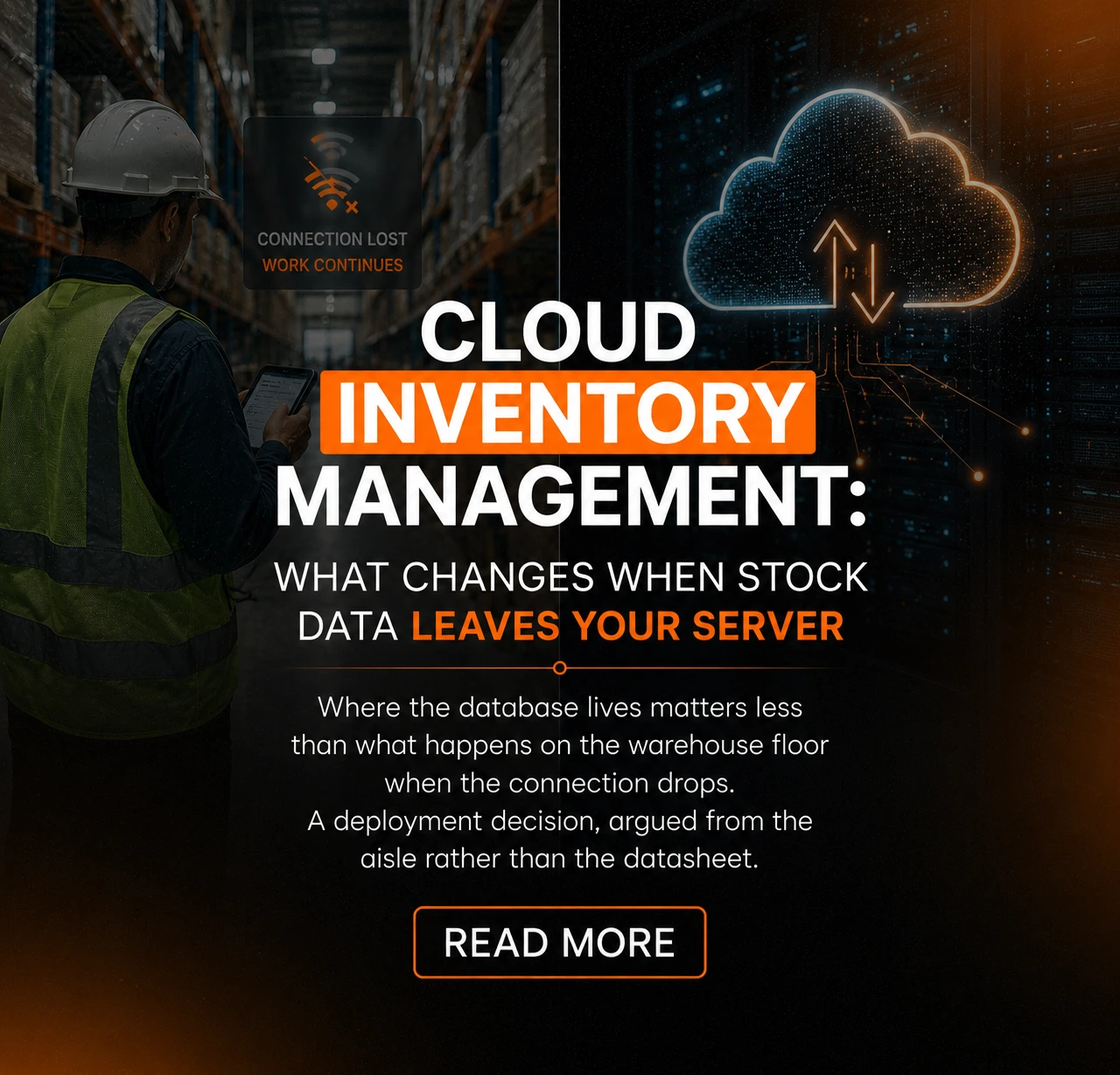
Cloud inventory management is an easy decision right up until the internet drops and the stock keeps moving. Goods still arrive at the gate, pickers still pull cartons off shelves, and none of it waits for the connection to come back. What matters is not where the database lives. It is what the scanner in the aisle does when it cannot reach it.
The short version
- For most operations the answer is cloud, and the condition that reverses it is connectivity at the site, not security.
- Vendor-hosted is not the same as your software on a rented VPS. The second is frequently sold as the first.
- The question that separates real products from brochures: what happens to receiving and picking during an outage.
- On-premise still wins on three genuine grounds — and none of them is "the cloud is less secure".
- Migration is the cost nobody budgets. Opening balances and SKU cleanup outlast the implementation.
The short answer
For most mid-market operations, cloud is the right deployment, and the reasons are unglamorous: no server to replace in four years, no upgrade weekend, and stock visible across sites without a VPN.
One condition reverses it. If a site cannot hold a usable connection for a full working day, and the software stops dead without one, then the deployment model is no longer an IT preference — it is an operational risk sitting on your receiving bay.
That is the whole decision. The rest of this article is the detail you need to defend it to a finance director, and the questions that separate a vendor who has thought about the aisle from one who has thought about the datasheet.
What cloud inventory management actually means
Cloud inventory management means the vendor hosts the application and the database, you reach it through a browser or a mobile app, and updates arrive without you scheduling them.
That last clause is the one that gets glossed over. Not scheduling upgrades is a genuine operational saving, and it is also a genuine loss of control over timing — a point worth raising with any vendor whose release notes you have never seen.
There is a second arrangement that is routinely sold under the same name and is not the same thing: your existing application, installed on a rented virtual server in somebody else's datacentre.
That is hosting, not a cloud inventory management system. You still own the upgrade, the backup policy and the database administration; you have simply moved the box.
Both are legitimate. Only one of them removes work from your team, and the difference is worth establishing in the first meeting rather than the third. A straightforward test: ask who applies the next version, and when. If the answer is "you tell us when you are ready", you are buying hosting.
Cloud based inventory software also tends to change the commercial shape of the purchase — a subscription against a licence, an operating cost against a capital one. Whether that helps depends on how your organisation budgets, which is a finance question rather than a technology one, and it should be answered by finance.
What genuinely improves
Four things change materially, and they are worth stating precisely because vendor copy tends to claim all four in a sentence and evidence none of them.
One stock truth across locations. Multi-site operations running separate installations spend real hours reconciling them, and the reconciliation is always slightly behind reality. Cloud based inventory management collapses that into one record because there is only one database.
No end-of-day sync ritual. If your branches currently push a file to head office each evening, your group stock figure is accurate once a day and stale for the other twenty-three hours.
Remote visibility that does not need IT. A director checking stock cover from a client meeting is a small thing that removes a surprising number of phone calls.
Counting on a phone. A cloud inventory system with a mobile app turns a stock count into something a supervisor runs with the device already in their pocket, rather than a terminal-server session on a laptop wheeled into the warehouse.
That lowers the cost of counting often, which is what makes continuous cycle counting practical — a change of method rather than of hosting, and one covered properly in perpetual versus periodic inventory.
What none of these four change is the shape of the work inside the building. Directed put-away, pick paths and bin-level location are a different category of question, and where a deployment decision meets them is covered in warehouse management system vs inventory software rather than here.
The offline question, which is the one that matters
This is the section to read if you read no other.
Stock does not stop moving because the connection dropped. Goods arrive, pickers pick, and every one of those movements is either captured or lost.
A CRM tolerates an outage. Someone logs the call an hour later and nothing is materially wrong. Inventory does not work that way: an unrecorded goods receipt is a stock figure that is now wrong, and it stays wrong until a physical count catches it, which may be months.
So the question to put to every vendor is narrow and specific. What can the warehouse still do with no connection, and what happens to that work when the connection returns?
There are three honest answers. The system queues movements on the device and syncs them on reconnect, with a defined rule for conflicts. The system degrades to read-only, so picking continues against a stale list and receipts wait. Or the system stops, and so does the warehouse.
All three exist in products being sold today. Only the first is usually implied by the brochure.
Do not accept the claim on paper. Ask for it demonstrated: put the device in flight mode, receive a line, pick a line, adjust a quantity, reconnect, and watch what lands.
Then ask what happens when two people adjusted the same SKU while both were offline, because that is the case that separates a queue from a queue with a conflict rule.
A vendor who cannot show you that has not built it, whatever the deployment model.
Where the data lives, and who can ask for it
For businesses operating across Pakistan and the Gulf, data residency is a real contractual question rather than an abstract one, and it comes up most often in three ways.
A customer’s procurement team asks where your systems hold their data. A group parent applies a policy set somewhere else. Or a tender includes a residency clause that was written without much thought and still has to be answered.
The practical position is straightforward: ask the vendor which region hosts your instance, whether that is contractual or merely current, and what notice you get if it changes. Get the answer in the agreement rather than in an email, because the person who sent the email will have moved on by the time it matters.
We are deliberately not going to summarise the regulations here. The requirements differ by jurisdiction and by sector, they change, and a marketing article is the wrong place to source a compliance position. Ask your counsel what applies to you, then hold the vendor to it.
What on-premise still wins
Three grounds are genuine, and a vendor who dismisses all three is selling rather than advising.
A datacentre you already staff. If the servers, the backup regime and the people are already there and already paid for, a subscription is a new cost replacing one you have largely absorbed. The saving argument is much weaker here and honest vendors say so.
A hard contractual requirement. Some defence, government and group-policy contexts specify on-premise and are not open to a technical rebuttal. That is a constraint, not a debate.
A site with genuinely unusable connectivity. Not "slow sometimes" — a plant on an industrial estate with one unreliable link and no practical alternative. If the offline behaviour above does not cover your operation, local is the correct answer and there is no shame in it.
What is not on that list is security in the abstract. Cloud deployment relocates risk rather than removing it: you gain a provider whose security team is larger than yours and lose the ability to inspect the room.
Which of those matters more is specific to your organisation, and anyone telling you cloud is inherently more secure has skipped the argument.
Migration is the cost nobody budgets
Deployment gets debated for weeks. Migration gets a line item and a fortnight, and it is where implementations actually slip.
Three pieces of work are unavoidable regardless of which model you choose, and they are worth scoping before you sign rather than discovering afterwards.
Opening balances. Every SKU needs a starting quantity and a starting value that finance will sign. That means a physical count, and the count has to be reconciled against a book figure that is usually wrong in ways nobody has had to explain before.
SKU normalisation. Most stock masters have accumulated duplicates, dead codes, and three spellings of the same item created by three people. Migrating that mess faithfully gives you the same mess in a more expensive system.
The cutover itself. There is a period where the old system is no longer authoritative and the new one is not yet trusted, and somebody has to decide which one wins for a fortnight.
None of this argues against cloud. It argues against believing the migration is the easy part, which is a mistake made at roughly equal rates in both directions.
How TimeTrax is deployed, since we should say
A deployment article that hides its own author’s model is not worth much, so: TimeTrax runs both. Cloud and on-premise are both supported deployments, and the choice is made per client rather than pushed.
In practice most new implementations are cloud, and the on-premise cases cluster around exactly the three grounds above — an existing datacentre, a contractual requirement, or a site where connectivity is genuinely not dependable.
We are not going to pretend that is an unusual position. Most established vendors offer both. It is worth stating plainly anyway, because the article would otherwise be arguing a case without declaring its own.
One last point, and it is the one that decides whether any of the above pays off. Hosting stock separately from purchasing and finance recreates exactly the reconciliation the move to cloud was supposed to remove — you have swapped a nightly branch sync for a nightly integration job, and gained a new place for the two figures to disagree. Stock, purchase orders and the ledger belong on one record, which is the case for an inventory management system that sits inside the same platform as procurement software rather than beside it. Where that platform is hosted is then a deployment question with a clear answer, and cloud erp is what most operations end up choosing.