Attendance Feeds Payroll
The month’s attendance is what payroll reads, not a sheet somebody prepared from it.
Where Employee Records Become Finished Work
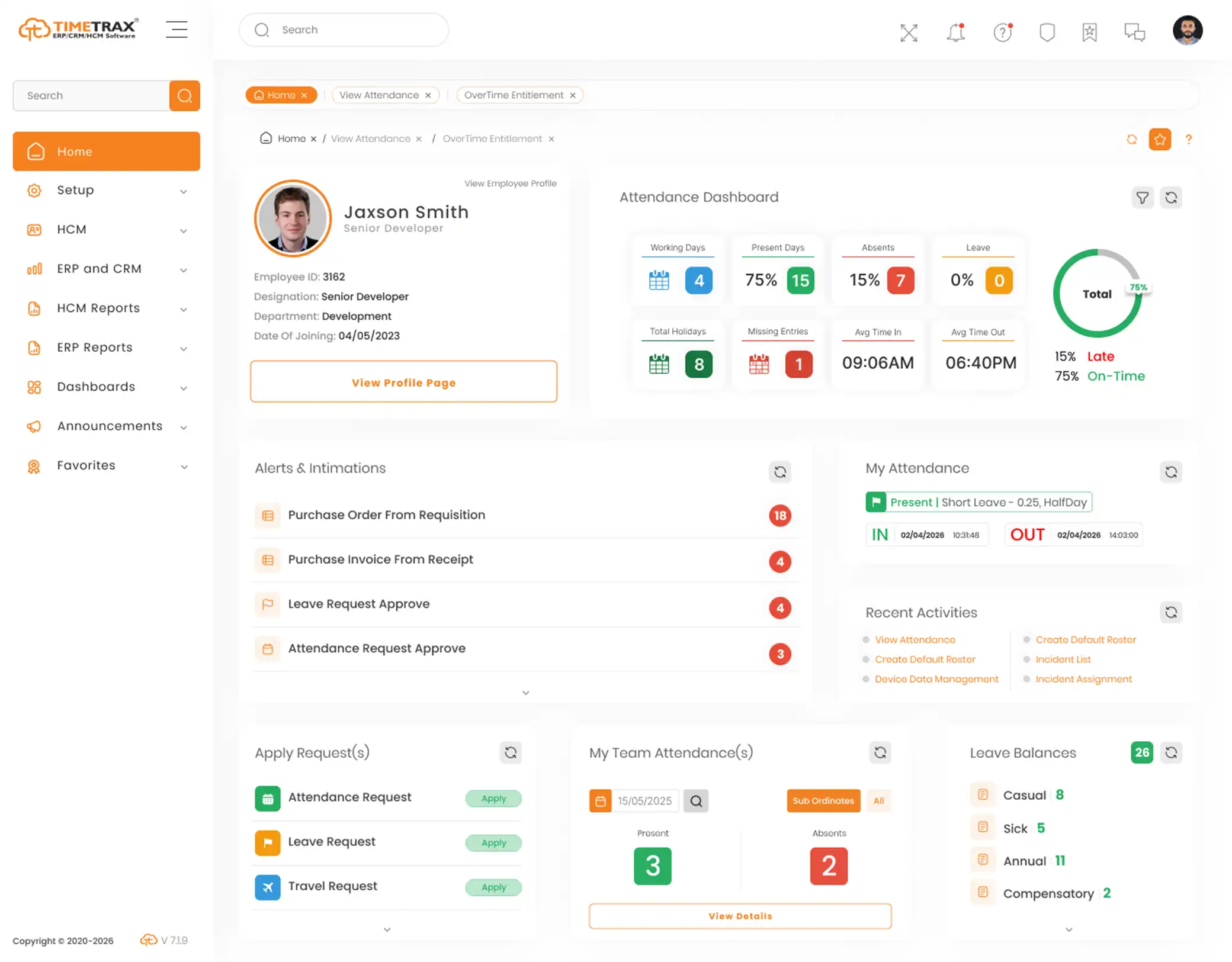
An HRMS is the layer that turns records into completed process. TimeTrax carries a leave approval into the attendance calendar and the attendance calendar into the payslip, so the chain runs on one database instead of three exports.
Trusted by 500+ Active Organizations across Multiple Industries
30th Year of Excellence
1 Million+ Employees Managed
Enterprise-Grade Security
Cloud & On-Premise Deployment
An HRMS — a Human Resource Management System — is HR software that holds the employee record and runs the day-to-day processes against it: attendance, leave, payroll, claims, performance and the approvals between them. The word that carries the meaning is management: an HRMS does not only store what is true, it moves work along.
That is also the practical test for whether you are looking at one. In a real HRMS an approved leave request changes the attendance calendar, and the attendance calendar changes the payslip, without anyone exporting anything. If those three steps are three systems joined by a spreadsheet, what you have is three tools and a monthly reconciliation job.
One chain from the door to the payslip, with no export in the middle.
The month’s attendance is what payroll reads, not a sheet somebody prepared from it.
Requests route up the reporting lines the system already holds.
Staff check balances and raise requests themselves instead of asking HR.
Attendance arrives from terminals and kiosks rather than from a register.
A payroll cycle that starts by exporting attendance
Leave approved in one system and invisible in another
Overtime and shift rules applied by hand, differently each month
HR answering the same balance question all day
Approvals stuck with whoever is on leave
No audit trail for who changed an entitlement, or when
The processes an HRMS is expected to run end to end.
Shifts, rosters and exceptions captured as they happen.
Entitlement, accrual and approval driven by the policy as configured.
Earnings, deductions and adjustments resolved against real attendance.
Claims raised, routed and settled without a paper trail.
Goals, reviews and ratings on a defined cycle.
One queue for the requests that currently arrive by email.
The question that separates the options is not the feature list. It is where the joins are, and who maintains them.
A records system with payroll run outside it is a real and common arrangement, and it is fine while the payroll is simple. It stops being fine the month attendance starts driving pay, because that is the month the export becomes load-bearing.
Picking the strongest attendance tool and the strongest payroll tool can beat a suite on both. The honest cost is that the integration is now a system you own too - it needs testing every time either vendor ships a change.
TimeTrax runs the chain on one database, so there is no export to own. The trade is breadth against depth: if one function is genuinely specialised beyond what a suite does, say so early and we will tell you whether this is the wrong fit.
Whether you’re replacing manual processes or upgrading from a legacy system, TimeTrax provides the technology, expertise and support to help you succeed.
Manage large workforces, multiple shifts, overtime, attendance, leave and payroll with greater accuracy while improving operational efficiency.
Support distributed teams across multiple branches with centralized employee management, real-time tracking and streamlined HR processes.
Simplify workforce scheduling, credential management, shift planning and compliance while ensuring uninterrupted healthcare operations.
Manage faculty, administrative staff and support teams through a centralized HR platform with automated attendance, leave and payroll.
Track employees across warehouses, distribution centers and field operations while improving workforce visibility and productivity.
Handle complex workforce structures, production shifts, attendance and payroll efficiently across factories and manufacturing units.
Create a modern employee experience with digital HR processes, self-service, performance management and workforce analytics.
Manage shift rotations, seasonal staffing, attendance, leave and payroll while delivering a seamless experience for employees and HR teams.
Connect HR processes with the systems your business already relies on.





From initial planning to post-go-live support, our specialists work closely with your team to configure the system around your business processes, migrate existing data and ensure a smooth transition.
We understand your specific business requirements to recommend the best implementation approach.
Our team configures workflows, policies, user roles and integrations to align the platform with your existing operations.
Employee records and historical data are securely migrated, followed by thorough testing to ensure everything works as expected.
We train HR teams, managers and employees before launching the system, backed by continuous support for a successful rollout.
Show us how attendance reaches payroll today, and we will show you the same chain with the export taken out of it.
HRMS, HRMS software, HRMS system and human resource management system all name the same thing, and HRMS portal usually means the self-service front of it that employees see. The distinction worth keeping is against its neighbours: an HRIS is the record layer an HRMS is built on, and HCM software is the same system with hiring, development and workforce planning added on top. If the acronym matters less to you than the outcome, the question to ask a vendor is simply how many exports stand between attendance and pay.
The processes named here have their own pages: Attendance Management, Leave Management, Payroll Software and Appraisal Management. The broader category sits on HR software.
Everything you need to know about HRMS software and what TimeTrax runs.
An HRMS, or Human Resource Management System, is HR software that holds the employee record and runs the processes against it: attendance, leave, payroll, claims, performance and the approvals between them. The management part is what separates it from a records-only system.
An HRIS is the system of record - who works here, on what terms, with which documents. An HRMS includes that record and adds the processes run against it. In practice most vendors sell an HRMS and some still call it an HRIS, so ask what it does rather than what it is called.
No. HCM software is broader: it adds the strategic layer - recruitment, onboarding, learning, succession and workforce planning - on top of the operational processes an HRMS runs. An HRMS is where HCM starts, not a smaller version of it.
It should, or it should feed payroll without an export. Payroll is the process most dependent on attendance and leave being correct, which is why it is the usual test of whether an HRMS is genuinely one system.
Yes. Self-service is what stops HR being the lookup service for leave balances and payslips. TimeTrax offers it through the web and through kiosk terminals for staff who do not work at a desk.
From the devices at the door as well as from software. TimeTrax supports biometric terminals, face recognition and kiosks, so attendance is captured where people actually arrive.
Multi-entity and multi-location operation is part of what the organization structure in TimeTrax is for. Confirm the specific arrangement you need with the team before implementation rather than assuming it from a feature list.
Yes, and on-premise as well. The deployment choice does not change which modules are available.
An HRMS earns its keep in the week nobody talks about — the one between the cut-off and the payslips. That week is short when the data never had to move between systems.