One Record, With History
Changes are recorded as a sequence of facts, not written over the last one.
One Employee Record You Can Actually Trust
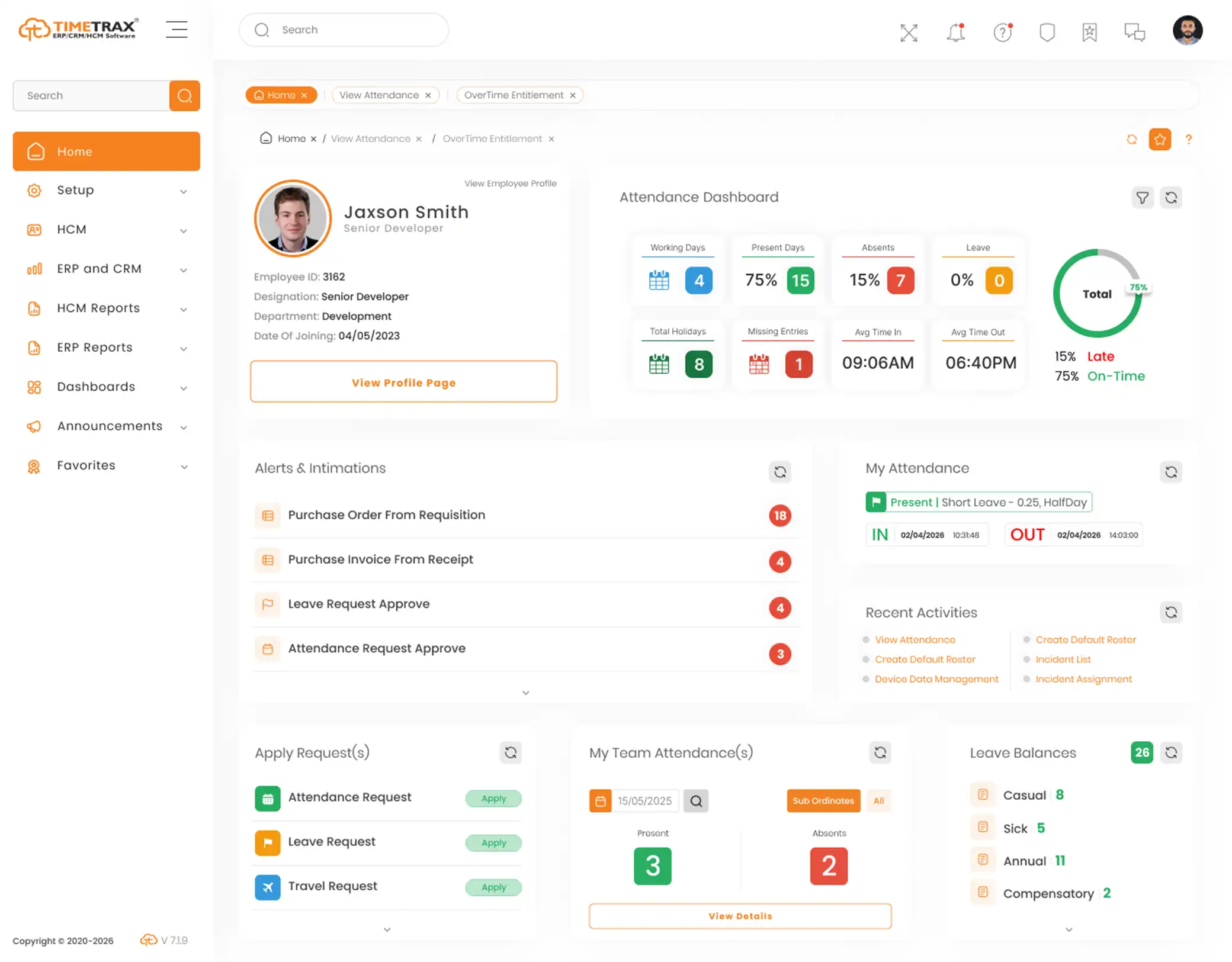
An HRIS is the answer to who works here, on what terms, and what proves it. TimeTrax holds that record once — with history, documents and structure attached — so every report and every process is reading the same version.
Trusted by 500+ Active Organizations across Multiple Industries
30th Year of Excellence
1 Million+ Employees Managed
Enterprise-Grade Security
Cloud & On-Premise Deployment
An HRIS — a Human Resource Information System — is the system of record for people data. It holds who works here, on what terms, in which part of the organization, with which documents and which history, and it is the thing every other HR process resolves against. Its job is accuracy rather than throughput.
That focus is why an HRIS is judged differently from the rest of HR software. The useful questions are whether a change is recorded as history or written over the top of what was there, whether one employee can exist twice, and whether a report run twice gives the same answer. A system that moves work quickly but cannot answer those is not a record you can rely on.
Master data that the rest of the system reads, rather than copies.
Changes are recorded as a sequence of facts, not written over the last one.
Entities, locations, departments and reporting lines held once and shared.
Contracts and certificates filed against the person they belong to.
Headcount and movement reports drawn from the record rather than rebuilt.
Two records for the same employee, both partly right
A headcount that differs depending on who ran the report
Documents in a shared drive nobody is responsible for
No history: the system only knows today’s version
Department and cost centre lists that finance does not recognise
Certificates and contracts expiring with nobody watching
What a system of record has to hold before anything is built on it.
Personal, employment and contractual detail on one record.
Transfers, promotions and status changes kept as a sequence.
Entities, locations, departments, designations and reporting lines.
Contracts and certificates stored against the employee record.
Headcount, movement and composition drawn straight from the record.
Who may see a record, and what was changed on it.
An HRIS is bought for the years after go-live, not the weeks after it. Judge it on what it can still tell you in three years.
The honest version of this is better than it sounds: a well-kept folder per employee is a real record, and small organizations run on it for years. What it cannot do is answer a question about all of them at once without somebody reading every file.
A records-only system is the right purchase when the processes genuinely live elsewhere - a separate payroll bureau, for instance. It is the wrong purchase if you expect it to also run leave and attendance, because that is an HRMS and you will be buying twice.
TimeTrax holds the record as master data that its other modules read, so there is one version rather than a master and several copies. That only pays off if those modules are in scope; as a pure filing system it is more than you need.
Whether you’re replacing manual processes or upgrading from a legacy system, TimeTrax provides the technology, expertise and support to help you succeed.
Manage large workforces, multiple shifts, overtime, attendance, leave and payroll with greater accuracy while improving operational efficiency.
Support distributed teams across multiple branches with centralized employee management, real-time tracking and streamlined HR processes.
Simplify workforce scheduling, credential management, shift planning and compliance while ensuring uninterrupted healthcare operations.
Manage faculty, administrative staff and support teams through a centralized HR platform with automated attendance, leave and payroll.
Track employees across warehouses, distribution centers and field operations while improving workforce visibility and productivity.
Handle complex workforce structures, production shifts, attendance and payroll efficiently across factories and manufacturing units.
Create a modern employee experience with digital HR processes, self-service, performance management and workforce analytics.
Manage shift rotations, seasonal staffing, attendance, leave and payroll while delivering a seamless experience for employees and HR teams.
Connect HR processes with the systems your business already relies on.





From initial planning to post-go-live support, our specialists work closely with your team to configure the system around your business processes, migrate existing data and ensure a smooth transition.
We understand your specific business requirements to recommend the best implementation approach.
Our team configures workflows, policies, user roles and integrations to align the platform with your existing operations.
Employee records and historical data are securely migrated, followed by thorough testing to ensure everything works as expected.
We train HR teams, managers and employees before launching the system, backed by continuous support for a successful rollout.
Bring us the reports that currently disagree with each other, and we will show you what one employee record does to them.
HRIS, HRIS system, HRIS software and human resource information system are one term, and employee database software is the plainer way of saying it. The neighbours matter more than the synonyms here: an HRMS is this record with the processes added, and human capital management software is both of those with hiring, development and planning on top. Vendors use the three names loosely, so the question to ask is which of the layers you are actually being sold.
The record itself is Personnel Management, the structure around it is Organization Management, and the filing sits in the Document Management System. The umbrella category is HR software.
Everything you need to know about HRIS systems and how TimeTrax holds the record.
An HRIS, or Human Resource Information System, is the system of record for people data: who works here, on what terms, where they sit in the organization, and which documents and history support that. Every other HR process resolves against it.
An HRIS is the record; an HRMS is the record plus the processes run against it, such as attendance, leave and payroll. The names are used loosely in the market, so it is more reliable to ask what a system does than to trust which acronym it is sold under.
An employee database is the plain description of the same idea. The difference in practice is history and structure: a database can hold the current values, while an HRIS is expected to keep how they changed and where the person sits in the organization.
Because most HR questions are about change rather than the present - what someone was paid before the promotion, when a transfer took effect, how headcount moved over a year. A system that overwrites the old value cannot answer any of them.
Yes. TimeTrax includes document management, so contracts and certificates are filed against the employee rather than in a separate drive with its own naming convention.
Not by definition. A records-only HRIS feeds payroll but does not run it. In TimeTrax the record and payroll sit on the same platform, which is what removes the export between them.
That is an access control decision rather than a product one, and it is worth settling before implementation. TimeTrax applies access rules to records and keeps an audit of changes.
Multi-entity and multi-location structure is part of what organization management in TimeTrax holds. Confirm the specific arrangement you need with the team before implementation.
The value of a system of record shows up late: in the audit, the restructure and the report somebody has to defend. All three are easier when there was only ever one version of the record.